

Left: actually viewed; right: computer reconstruction based on brain imaging
Well, it looks like the future is finally here. I wasn’t quite sure how it was going to present itself, but it seems to have come in the form of UC Berkeley scientists who have developed a “decoder” that can measure our brain activity and reconstruct our visual experiences. In other words, 20 years from now we might not ask eye-witnesses to describe a suspect…we’ll just analyze their brain activity and reconstruct the suspect’s image for ourselves.
I couldn’t make this stuff up if I tried.
I’ll be honest: I would be way out of my league if I tried to give a technical account of how the decoder works, but this research is so mind-blowing that I had to share it.
The scientists behind this project were dedicated, spending hours being as still as possible inside an MRI machine so that a functional MRI (fMRI) could measure the blood flow through the visual processing centers of their brains while they watched movie trailers. Each second, a computer made associations between the images in the movie and the resulting activity in the brain.
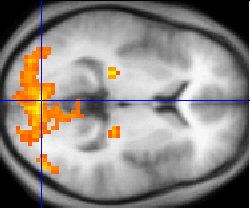
fMRI image
The decoder algorithm developed by these researchers can describe how temporal and spatial information are represented by fMRI data. Five thousand hours of random YouTube video clips were fed into the computer and this same algorithm predicted the types of fMRI responses these clips would elicit. From this, the researchers were able to take the fMRI data generated while movie trailers were viewed, then reconstruct the images seen by the person using composites of YouTube videos that had the most similar predicted fMRI signature to the real data. The results I’m showing below may look crude, but the fact that they’re just based on an algorithmic analysis of fMRI data is incredible.
On the left is a still from the actual trailer viewed by the subject, and on the right is the composite put together by the algorithm:


 A continuous video composite created by the algorithm is embedded below:
The implications of this go far beyond being able to see a fuzzy recreation of something you’ve already seen, or even my hypothetical future scenario of computer-generated criminal suspect renditions. This technology could allow us to have computer-generated versions of our dreams, which we could show to anyone we wanted. People who are physically paralyzed would potentially have an entirely new means of expression. And what would the images generated by a schizophrenic mind look like?
Like I said…the future is definitely here.

Naselaris T, Kay KN, Nishimoto S, & Gallant JL (2011). Encoding and decoding in fMRI. NeuroImage, 56 (2), 400-10 PMID: 20691790
Shinji Nishimoto, An T. Vu, Thomas Naselaris, Yuval Benjamini, Bin Yu, Jack L. Gallant. Reconstructing Visual Experiences from Brain Activity Evoked by Natural Movies. Current Biology, 22 September 2011


I recommend you look at this page: https://sites.google.com/site/gallantlabucb/publications/nishimoto-et-al-2011
It has a good description of this project. The images weren’t reconstructed from scratch. Each one is a composite of several YouTube videos that nearly match the data received from the fMRI scans.
Yes, that’s the 5000 hours of YouTube videos I refer to…hope I didn’t make the concept more confusing! Thanks
Okay. My mistake. In my defense, though, everything above the fold makes it look sound like the images were constructed using only the scans and the computer program. That’s still no excuse, though, for my quick read and hasty comment.
I feel that is among the so much vital information for me. And i am satisfied studying your article. But want to statement on some normal issues, The site style is perfect, the articles is in reality excellent : D. Excellent process, cheers