
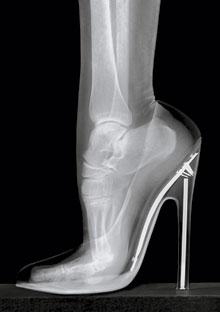
 At least a couple of times a month, I thank my lucky stars that I’m 5’11″ inches tall. For me, wearing high heels
 is overkill at best, and painful at worst. Sure, I’ll wear them on occasion (I’m not immune to fashion), but it’s always with a heavy heart, and after much deliberation. In my perfect world, high-heeled shoes would not exist.
Turns out, Jessica Simpson and I have differing opinions on this issue (and on many others, I presume; to be fair, the woman is 5’3″):
“I think when my mom had me I came out wearing high heels – I even go to the beach in them!”
She also provided this gem:
“I’d rather have a great pair of high heels than a hug.”
I know you can’t see me slowly shaking my head in pity right now, but maybe when you read this post you’ll give second thoughts to artificial height enhancement.

That can't feel good.
The practice of wearing high heels probably dates back to ancient Egypt, but that doesn’t make it right. Back then, high heels were most likely worn ceremonially, but today they’re a staple of women’s fashion. They make the wearer appear taller, with longer-seeming legs and emphasized bust and buttocks to boot. But the drawbacks to high-heeled shoes are in the things you can’t always see, things that probably make a woman (or man — we don’t discriminate here at Try Nerdy) feel less than sexy.
Here’s a list of of some ways that science seems to justify my high heel hate…beauty is pain, indeed:
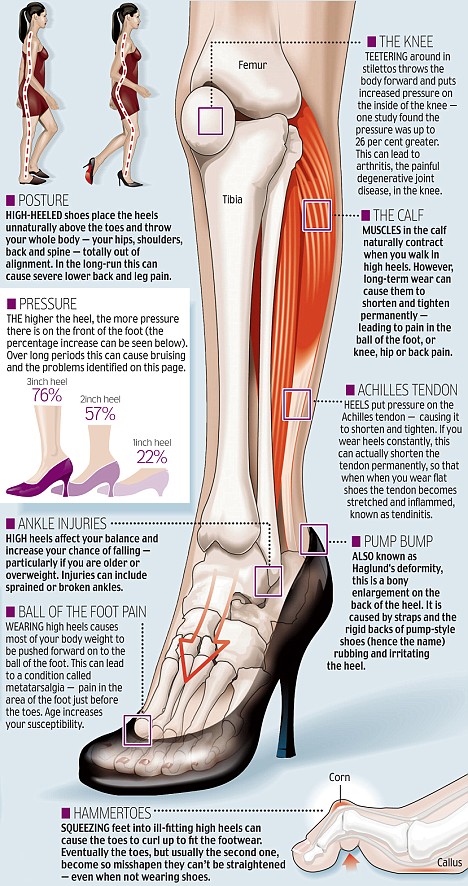
1. High heels can lead to heel and ankle pain. Well, here’s an obvious one. Although the heel and ankle pain in this case is of a chronic nature, as opposed to pain only when you’re wearing the heels. That is, how much heel-wearing you do today could do you in for pain later in life. In this study that included over 3,300 men and women, over 60% of women reported regularly wearing “poor” shoes (including high heels) in the past, compared to only 2% of men. In women, a significant correlation was found between hind-foot pain and past shoe wear that included high heels.

WTF?
2. High heels alter the electrical activity in your lower back muscles. In this study, women between the ages of 20 and 55 were made to walk across a flat surface without shoes, in low heels (4 cm), or in high heels (10 cm). Higher bioelectrical activity was recorded in the “cervical paraspinal” muscles of the women in high heels, an effect that was even greater if they were 45-55 years old. This was hypothesized by the researchers to not be safe for the spine, and to be a potential risk factor for chronic lower back muscle fatigue.

3. High heels can shorten your muscle fibers and thicken your tendons. Last year, scientists in Austria reported on their findings on women who, perhaps counter-intuitively, feel pain when walking flat-footed. These women were habitual heel-wearers, and ultrasounds revealed their calf muscle fibers to be 13% shorter than those of women who wear flat shoes. Not only that, the women who wore high heels had substantially thicker and stiffer Achilles’ tendons, presumably to compensate for the shortened calf muscle fibers so that the calf could function optimally while walking. However, their thick and stiff tendons couldn’t stretch sufficiently and led to reports of pain in this area.
Hopefully Jessica Simpson incorporates some calf stretches into her day. I will stick with my lean, limber Achilles, thankyouverymuch.
4. High heels can lead to joint degeneration and osteoarthritis of the knee. A study out of Iowa State University focused on three heel heights: 0 inches, 2 inches, and 3.5 inches. The higher the heels were, the more compression that was experienced by the inside of the knee. Findings from a high heel study in Denmark corroborate the knee osteoarthritis link by showing that wearing a 9 cm heel causes the wearer to flex the knee joint significantly more when walking, leading to a large increase of bone-on-bone forces in the knee. The ISU study also found altered joint positions at the ankle, knee, hip, and trunk, which changed overall posture and could cause strain on the lower back.

Should've gone with the flats!
5. High heels can lead to calluses, bunions, and hammertoes. Not sexy. There isn’t too much fancy science here. When you wear heels, gravity pushes your foot forward against the front of the shoe. Also, the front of a high-heeled shoe is often more tapered than a foot is. All that pressing and squeezing into the shoe can mean (1) corns: tough, thickened patches of skin caused by excessive friction and pressure; (2) bunions: the inward turning of the big toe (encouraged by pointy shoes) as a deformity that causes the big toe joint to jut out to one side, and which may be accompanied by swelling; and (3) hammertoes: the permanent curling up of the toes (usually the second, third, or fourth toes), even when the shoes are off, in response to habitually squeezing into shoes that don’t fit.
The ugly truth:

Maybe some of you are calling me a feminist right now, but I call myself an anti-pain-and-chronic-injury-ist. And, I’m not crusading for everyone to give up high heels, just advocating for people to know what they might be in for down the line.
Click the image below to enlarge and read more on the physiological consequences of heel-wearing.

Dufour AB, Broe KE, Nguyen US, Gagnon DR, Hillstrom HJ, Walker AH, Kivell E, & Hannan MT (2009). Foot pain: is current or past shoewear a factor? Arthritis and rheumatism, 61 (10), 1352-8 PMID: 19790125
Mika A, Oleksy Ł, Mikołajczyk E, Marchewka A, & Mika P (2011). Changes of bioelectrical activity in cervical paraspinal muscle during gait in low and high heel shoes. Acta of bioengineering and biomechanics / Wroclaw University of Technology, 13 (1), 27-33 PMID: 21500761
Csapo R, Maganaris CN, Seynnes OR, & Narici MV (2010). On muscle, tendon and high heels. The Journal of experimental biology, 213 (Pt 15), 2582-8 PMID: 20639419
Simonsen EB, Svendsen MB, Norreslet A, Baldvinsson HK, Heilskov-Hansen T, Larsen PK, Alkjær T, & Henriksen M (2011). Walking on High Heels Changes Muscle Activity and the Dynamics of Human Walking Significantly. Journal of applied biomechanics PMID: 21908897


I’m 5’10, so I share in your thankfulness. I can’t do the heels thing for the reason of—well, basically all the images you posted!
I’ve never worn high heels in my life (at 5’7” also not strictly necessary) – even my wedding shoes were flat. I can’t understand why a woman would torture her feet that much.
Cool post. I hate high heels, they make me feel out of control. I was wondering if you wrote it with Dr Isis in mind…
I haven’t heard of a Dr. Isis….I’ll check him/her out!