
 I’ve grown up with video games my entire life, but my taste in games has remained fairly constant: I want to run around and collect coins or some such thing, without having to feel stressed. However, for many others who started out playing Super Mario
 , their preferences have evolved to include games that are much more realistic
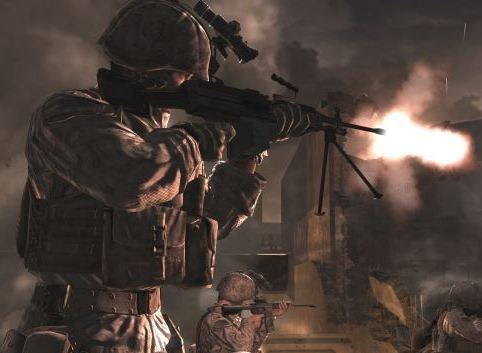
 and, oftentimes, much more violent
 .
I’ll be honest, I gave a violent video game a try once…but when I found myself sobbing ten minutes into a Resident Evil
 .
Many of the gamers enjoying this genre are undoubtedly young males, so it was fascinating to see what Indiana University researchers discovered in the brains of 18-29 year old guys after just one week of playing violent video games.
Up until now, a lot of the speculation about the effects of video games on the people who play them has been correlative. For example, a popularly made point is that kids who play violent video games go on to show more aggression. But then, who’s to say that aggressive kids aren’t just more likely to choose to play a violent game?
But now, a step has been taken to show cause-and-effect between playing violent video games and changes occurring in brain activity. Scientists at Indiana University recruited 28 males between the ages of 18 and 29 (a somewhat small sample size) who had little previous exposure to violent video games. These men were randomly assigned to two groups of 14, and the first group was instructed to play a “shooting game” for 10 hours at home one week, then play nothing the second week. The rest of the men played no video games during the two weeks.
Each of these men had functional MRIs (fMRIs) done at the beginning of the study, as well as at the end of the first and second weeks. This type of MRI can show which parts of the brain are most active. While receiving fMRIs, these men underwent an emotional Stroop test, which essentially tested how the degree to which their brains responded to violent vs. non-violent words.
This testing showed that after a week of playing violent games, the video game group showed less activation in the left inferior front lobe, in an area which I’ve circled in red below (second row, middle):
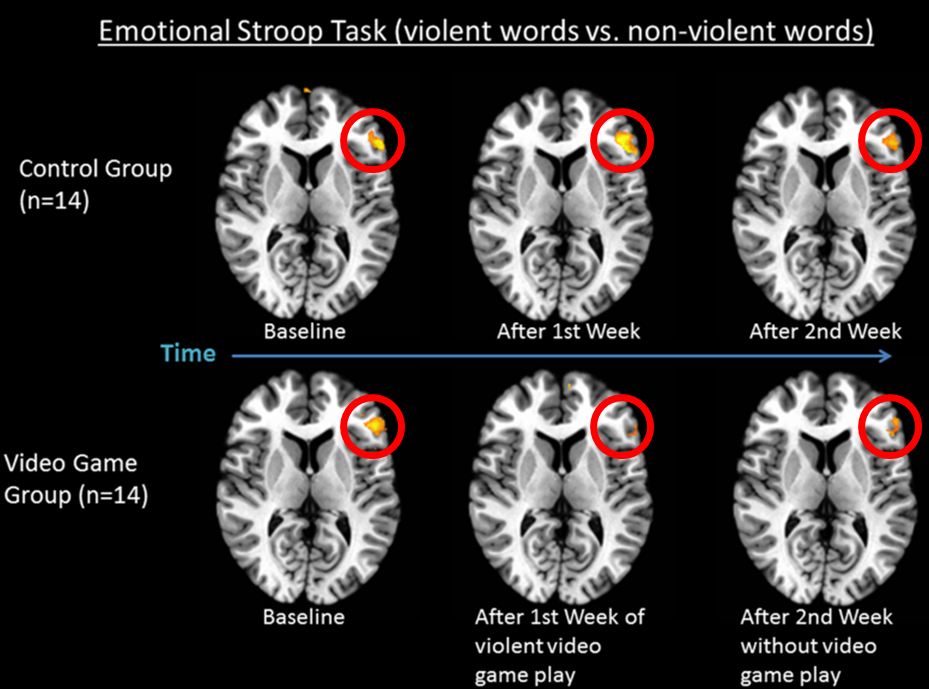
You can also see that after a week without game play, the gamers’ brains start to look more like those of the controls. While this study has its shortcomings, and it’s hard to say exactly how these changes in brain activity might manifest psychologically or behaviorally, it does show that gaming has a long-term effect on brain functioning. And these results were after a mere week of game play! Most gamers have been playing for years.
The lab that did this study has also researched the effects of violence in the media on adolescent brain activity; perhaps in the future, the combined results of these and other similar studies will have an impact on the restrictions imposed on video games and other forms of entertainment that blend reality with fiction.
 Kalnin AJ, Edwards CR, Wang Y, Kronenberger WG, Hummer TA, Mosier KM, Dunn DW, & Mathews VP (2011). The interacting role of media violence exposure and aggressive-disruptive behavior in adolescent brain activation during an emotional Stroop task. Psychiatry research, 192 (1), 12-9 PMID: 21376543


For fMRI, 28 actually isn’t too bad of a sample size – individual and group differences determined from the imaging data tend to be more powerful than behavioral testing outside of the scanner. It’s still on the low end, though, so a few more participants would be nice.
That said, I disagree with the conclusion that the data show a long-term effect on function. It’s true that they show short-term changes in gamers’ brains as a result of exposure to violent video games, but the fact that these changes go away as they stop playing the games show that the changes aren’t permanent. It would be more convincing if the gamers’ activations didn’t revert after a period of time without game play, since it would mean that any decrease in activation or connectivity required only a short period of exposure to violence and not much continued reinforcement, which is a pretty scary concept. It also looks like the study is mostly about how media violence affects people based on an existing predisposition to aggression, rather than how it affects the controls.
Sorry. I’m ranting. Point is, I’m inclined to stick this in my pile of studies that don’t really conclude anything new. I’d love to hear more of your thoughts on it.
I should’ve clarified what I considered long-term…I suppose I was surprised that the scans were still different a week after game play, as opposed to just during. They need to do this with people playing these games for much longer than a week….you make excellent points!
Hey NerdyOne
Did they test non-violent video games against violent video games? The data seem to show that video games affect the brain to some degree, but how much of that is from the games being “violent” isn’t really tested here. They need more controls, really. The only conclusion I could see being drawn from this experiment is that violent video games desensitize people to violence.
I’d also like to see how other activities affect the results of the stoop test, just to see how violent video games compare to actual violence or full-contact sports like football or hockey.
I also wonder why “violent video game” studies are so poorly controlled for, but I guess one might as well wonder at the sample size as well. Seems one would want to control versus non-violent video games as well as violent sports, or violent media in general.
Short of reading further, I’m also skeptical about the emotional stroop test — Seems plausible violent words from the test would overlap with terms specific to the gameplay, “shoot”, “kill”, “hit”,” guns”, “capture” et cetera. Would be nice to see a separate look at stroop results for non-violent gameplay words, such as “flag” , “assist”, “team” and so on.
I guess I am just not that surprised that violent video games cause some changes to the brain structure — doesn’t the act of learning any thing or participating regularly in any activity have measurable effects on the brain?
Games are fun precisely because they change your brain… you pick up long term skills and react differently from the first time you picked up a controller. Articles and studies that focus on violent video games without controlling for non-violent games, other violent media or violent sports just seems like pandering to the latest breed of moral panic.
Studies like this are a step in the right direction, but I’m with Adam. I would have liked to see three groups – a control with no video games, one group with non-violent video games (or perhaps just not very realistic, such as something somewhat cartoony, or no blood showing, like in World of Warcraft), and then another group with violent games.
And, as a gamer myself, I’d like to see the effect it has on women.
I’m really inspired together with your writing abilities and also with the layout to your blog. Is that this a paid theme or did you customize it your self? Either way keep up the excellent quality writing, it is uncommon to look a nice weblog like this one today..
Hi, thank you! I customized the WordPress Twenty-Ten theme
I think the significance here is that violent video games do have an immediate and at least short-lived effect on brain activity in this small sample. How that translates into behavior is hard to predict. The effect of long term exposure was not assessed. It may be that the effect does not translate into anything meaningful…or maybe it does but only under certain conditions.
I don’t think it is a jump to think that watching repeated images of violence could numb us to certain types of violence at least to some degree. We see this happen all the time in professions where people are forced to deal with things like violence or death on a regular basis etc. Unfortunately, so many things impact behavior and what impacts one person one way will not always impact another the same way or to the same extent because no two brains are the same and no two people have exactly the same experiences.
I think it has also been suggested that violent play offers some people an outlet for their aggression…so who knows. For every person that has a negative experience…there may be those unaffected or even those who have a positive experience.
I personally find the violence in some of these video games repulsive and think there are more productive ways to spend your time, so I am inclined to gravitate towards research that justifies my own personal views. I am not sure though, knowing what I know about the brain, that we will ever be able to draw strong and meaningful cause and effect relationships because of the complexity of factors that contribute to behavior. It is kind of like nutrition and trying to isolate how eating a particular nutrient in certain amounts for a given period of time will effect our health while teasing out all the other factors at play. It is really hard to do…even though we do try….and not suggesting we shouldn’t…