
 “It’s always lupus.”
I’ve watched enough episodes of House, M.D. (and it doesn’t take many) to know that when Dr. Gregory House and his medical team try to nail down each episode’s tricky medical condition, they often suggest a diagnosis of lupus along the way to the right answer.
I’m not unashamed to admit that until recently I couldn’t actually answer the question, “What is lupus?”…. Can you?
Don’t feel bad if you can’t; no one really knows what lupus is, because no one knows what causes lupus. In a nutshell, if you have lupus, it means your immune system has started attacking you — the very thing your immune system is meant to protect. It’s not known why the immune system starts doing this, but once it does, the condition is chronic and any part of your body can be targeted (kidneys, skin, hip joint, you name it).
Who gets lupus? Of the roughly 5 million people in the world with a form of lupus, most of them are women, and Blacks are more susceptible than Whites. You can’t catch lupus from anyone, and the best guess of how one ends up with lupus is through an inherited genetic predisposition (lupus sometimes occurs within families) that turns into full-blown disease after exposure to some environmental factor. A popular metaphor for this disease pattern is, “genes load the gun and environment pulls the trigger.”
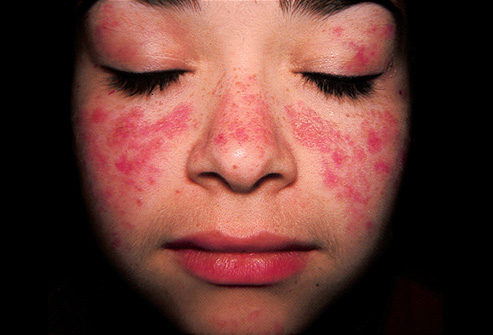
Image Source: Color Atlas of Pediatric Dermatology Samuel Weinberg, Neil S. Prose, Leonard Kristal Copyright 2008, 1998, 1990, 1975, by the McGraw-Hill Companies, Inc. All rights reserved.
Because lupus can affect the entire body, symptoms of lupus are wide and varied. Rashes, such as the one at left, are common when the skin is attacked, and patients often experience hair loss, fever, joint pain, seizures, and many other complications as well. In fact, the most common cause of death in lupus patients is kidney failure, because kidneys under immune attack become too inflamed to function.
Being diagnosed with lupus simply requires checking off enough boxes of lupus symptoms for a long enough stretch of time to be classified as having the disease. Unfortunately for lupus sufferers, there is no cure for the disease, and attacking the problem — the immune system — would mean making the patient vulnerable to a whole host of opportunistic infections. Easing pain and preempting complications are currently the field standard.
However, new hope for lupus patients arrived in March of this year, when the FDA approved the first lupus drug to hit the market in 50 years. The drug, belimumab, is an antibody therapy that basically inhibits the factor responsible for B-cells (a type of immune cell) making so many antibodies against the patient. The drug is not perfect, it’s best as part of combination therapy and it has its own side effects, but it’s a definite step in the right direction for effective treatments. It means even scientists are getting better at asking themselves, “What is lupus?”
Espinosa G, & Cervera R (2010). Belimumab, a BLyS-specific inhibitor for the treatment of systemic lupus erythematosus. Drugs of today (Barcelona, Spain : 1998), 46 (12), 891-9 PMID: 21589946
For more on lupus, you can visit http://www.lupus.org and do your own research:


mmmm…..hugh laurie’s eyes are giving me lupus
but seriously, greatness abounds in this site
A million thanks to you, my friend in nerdiness!
Thanks for shedding light on this! I live with it every day and have yet to understand its ways. My usual description of it is as civil war: my own body tears itself from within. Not fun But I’m excited for belimubab!
Wow, I’m really sorry to hear about that, although you sound like you’re not letting it get the best of you! I’m so glad that the research is ongoing to find something that works, and hopefully you find something that works for you in the not-too-distant future. .
And yeah, it didn’t seem right that I (and probably most people?) only knew lupus as a tagline from House! Thanks for stopping by
Is there any connection between Lupus & any type of cancer. My husband passed away from testicular cancer, but a year before that he was diagnosed with Lupus.
First off, I am so incredibly sorry for your loss. Johns Hopkins does suggest some links between lupus and cancer: http://www.hopkinslupus.org/lupus-info/lifestyle-additional-information/lupus-cancer/. There’s also a very interesting article on WebMD: http://lupus.webmd.com/news/20101108/lupus-linked-increased-risk-cancer. One thought is that immunosuppressive drugs decrease the body’s ability to fight against cancer. I hope that with future research that this link could be more fully explained.
All the best to you
Thanks for this. While I haven’t been affected by lupus in anything like the ways of some of the commenters above, not knowing anything about it has bugged me for a long time. When I was in high school, there were almost always a few ads on the bus about lupus. They were frustrating ads, because they didn’t answer any questions about the disease, they just talked about how you shouldn’t discriminate against people who have it… which is an obvious point and simultaneously baffling to the younger me. What is this thing called lupus, and why would one assume I’ll be mocking somebody who has it? The list of symptoms on the ads could be summarized as basically “feels bad” and “visible effect”, hence the “it’s always/never lupus” jokes on House.
Does the lupus is dangerous? how it affects our health? because my aunt had a diseas like that……..