
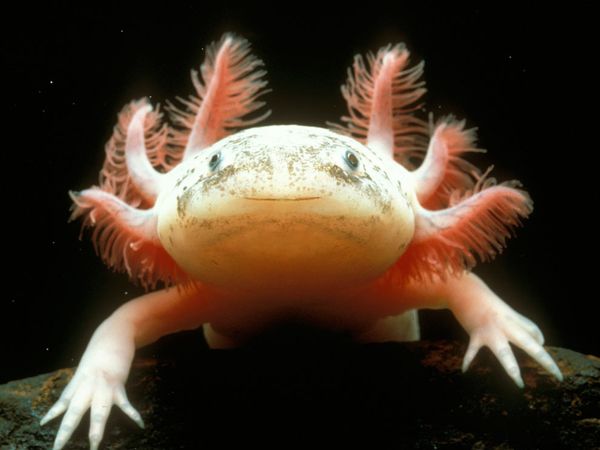
This is an axolotl...I can't decide if it's cute or terrifying.
You know, when you’ve been alive for at least a couple decades and you work in biological science, it’s pretty rare that you learn about an animal that you’d absolutely never heard of before. However, this happened to me yesterday. It was actually somewhat shocking, especially since I put value in keeping abreast of what sorts of animals are cohabiting my planet with me. I was also taken aback because at a first glance I thought scientists had finally engineered an aquatic rodent.
But, no, I was looking at an axolotl (sounds like “ACKS-uh-lottle”). To meet axolotls and other animals that you might not have known existed, click on.
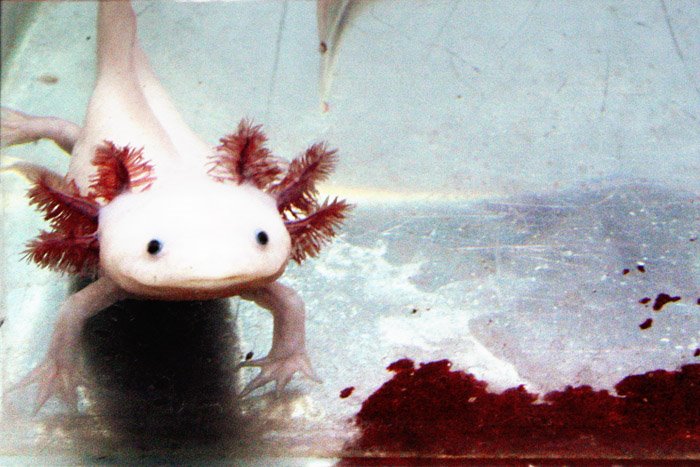
1. Axolotls. Despite the sci-fi appearance, axolotls are simply a type of salamander. They’re native to the Mexico City area and, unfortunately, are nearly extinct in the wild. The reason I saw axolotls in a lab was because they’re really good for studying limb development and regeneration. The axolotls that I saw happened to be mutants with reduced pigment, which probably raised the creepy factor, but the single most unsettling feature was those bright red brush-like things growing out of their faces! (I’ve since come to accept these external gills as being very cool) The more common color of axolotls is dark brown:
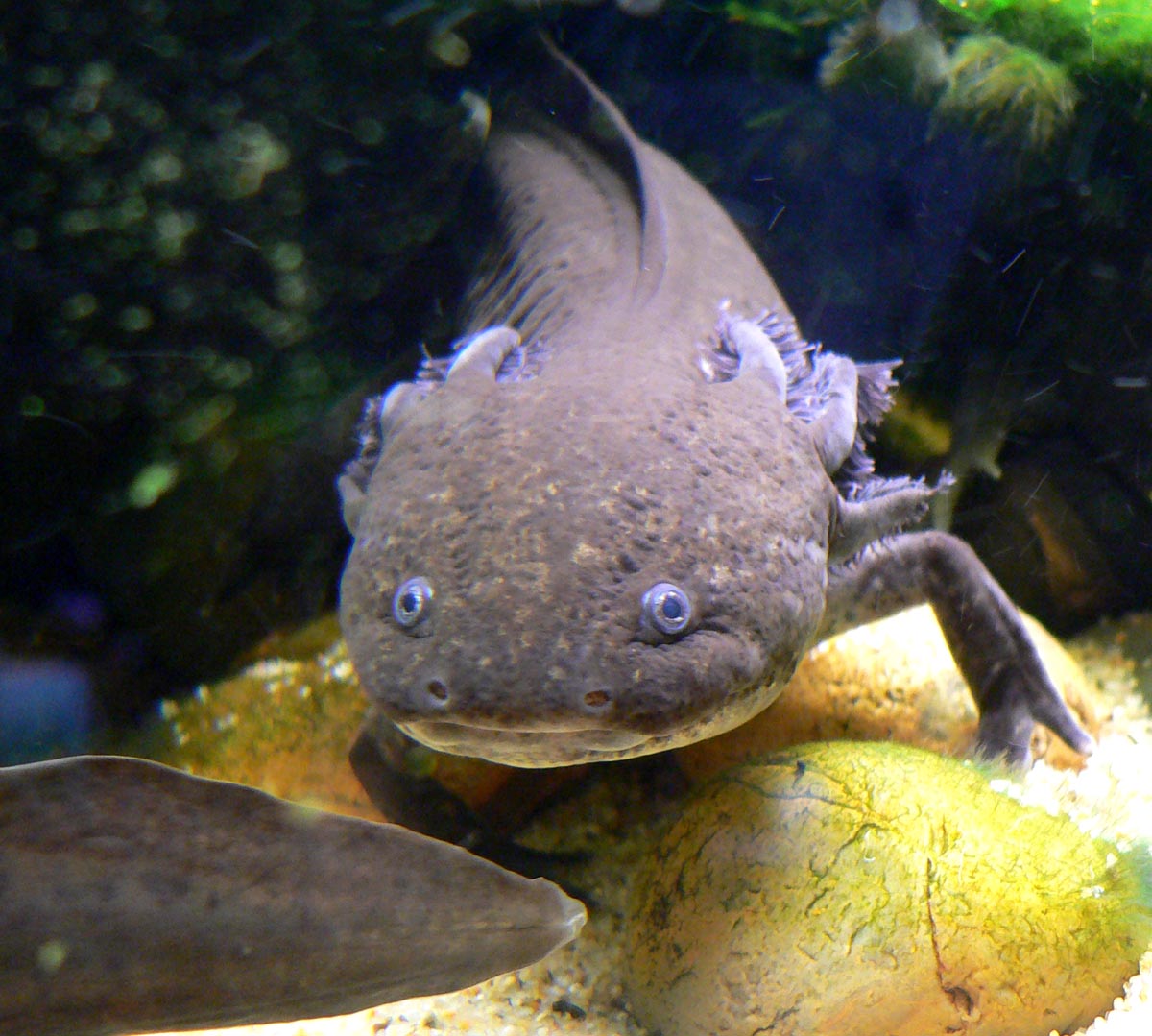
Cute?...Or creepy?
They’re amphibious, so they can breathe above and below water, and carnivorous; they eat bugs and small fish by sucking them into their mouths like a vacuum. Needless to say, I was totally impressed by these little guys, and it motivated me to research other animals I’d never heard of, and wouldn’t mind meeting some day. For example:
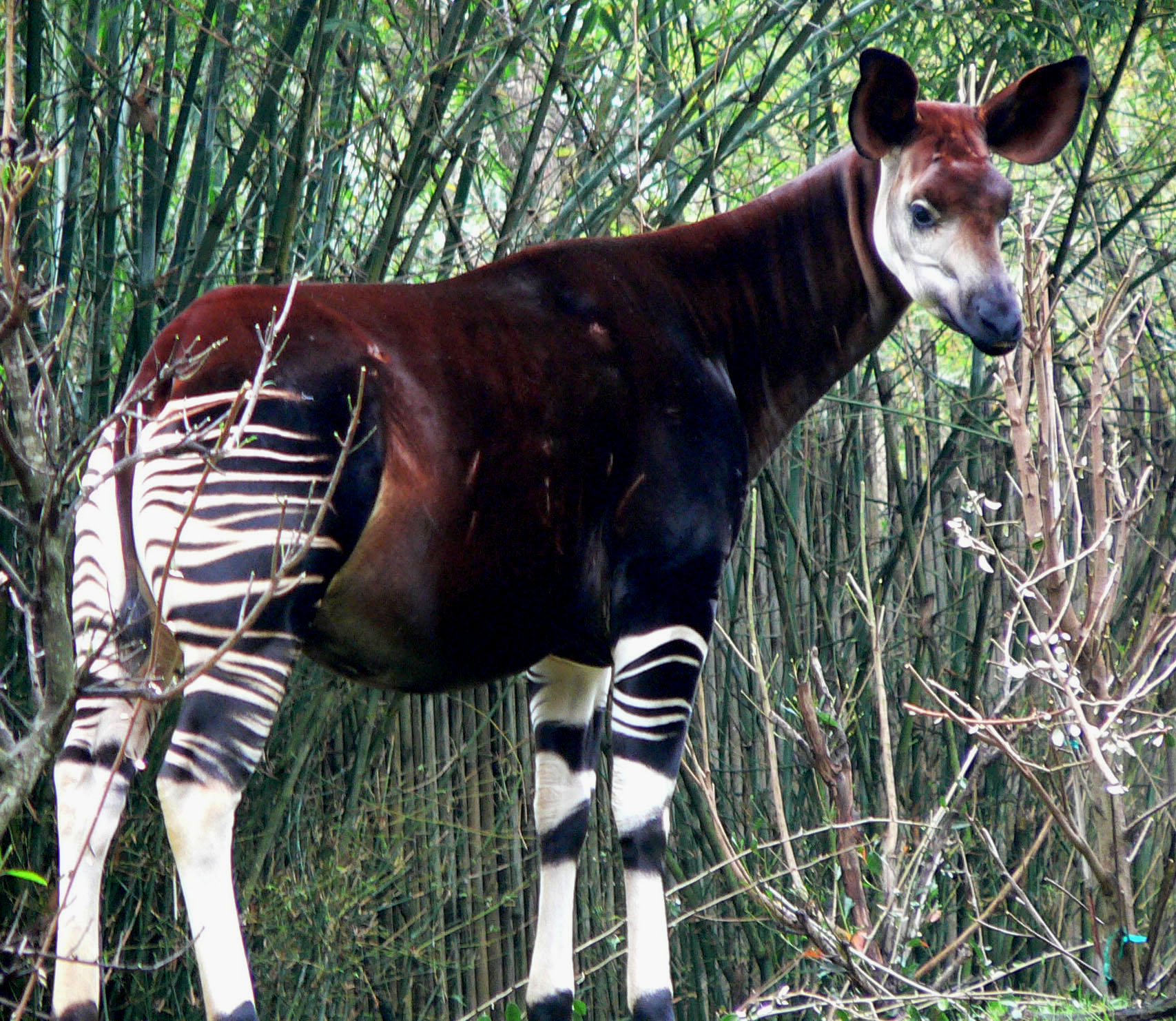
2. Okapis (sounds like “oh-COP-ees”). My first thought when I saw this picture of an okapi was, “…Whaaat?” It looks like nature started off planning to create a horse/deer, but then got bored at the end and decided it should make a zebra. Although the real twist is that okapis are most closely related to giraffes. While they aren’t yet endangered, their native habitat in the Democratic Republic of Congo in Central Africa is threatened. Nevertheless, it appears I can finally meet an okapi for myself when I go to Disney World next week. I might not get too close, though, because okapis are pretty wary of humans, and they can be over 6 1/2 feet tall and weigh in excess of 600 lbs (i.e. I’ll be pretty wary of the okapis, too).
Not to alarm you, but check out this little guy I’d also never heard of:
 3. Aye-ayes (sounds like “eye-eye”). Really not a looker, the aye-aye is a type of lemur (although I would’ve guessed it to be a bat), and strikingly reminiscent of this thing from the movie Gremlins:

The niftiest thing I’ve learned about the world’s largest nocturnal primate (they reach about 4 pounds) is that they have a long, skinny specialized middle finger for tapping on trees and fishing out bugs to eat. Sadly, the aye-aye, like other incredibly fascinating animals, is endangered. Aye-ayes are often killed on sight in their native Madagascar, where many believe them to be an omen of evil or death. Superstition has it that if an aye-aye points its long, skinny middle finger at you, you will die unless that aye-aye is killed – a much harsher interpretation than of the human version of giving the finger. Aye-ayes are actually relatively harmless when it comes to humans, and thankfully there are now laws to protect them. Plus, the longer I look at it, the more it grows on me.
The same is not true of this fella:

4. Star-nosed moles. While I’ve heard of moles before, I almost wish I’d never heard of the star-nosed mole. I mean, I totally respect the right of every animal to exist, but looking at this one makes me increasingly uncomfortable – if you can get past the “nose,” look at those huge paws and claws! They use the 22 tentacles on their faces to feel out their food, and I guess I’m more accepting of the alien-like noses when I consider that they help make these critters the fastest-eating mammals in the world. That is, they can feel prey and decide whether it’s edible in 8 milliseconds, which is at the limit of the speed of neurons. The nose tentacles even let them smell things underwater by blowing bubbles onto stuff and sniffing the bubbles back up. These moles are a little closer to home, living in the northeastern U.S. and eastern Canada, but if I ever come across one I’ll probably just try to respect it from a distance.
Lastly, despite my entomophobia (and the fact that I’ve somehow managed to feature insects on this site multiple times already), I want to quickly share a couple bugs that are new to me, but have already earned my respect. First,

5. Honeypot ants. If I were a comedian, I would insert a really great joke about Sir Mix-A-Lot’s “Baby Got Back
Moving on…
Chameleons change color. Stick bugs look like sticks. And that used to really impress me until I learned about this next and final bizarre animal that is a few steps ahead in the camouflage game:
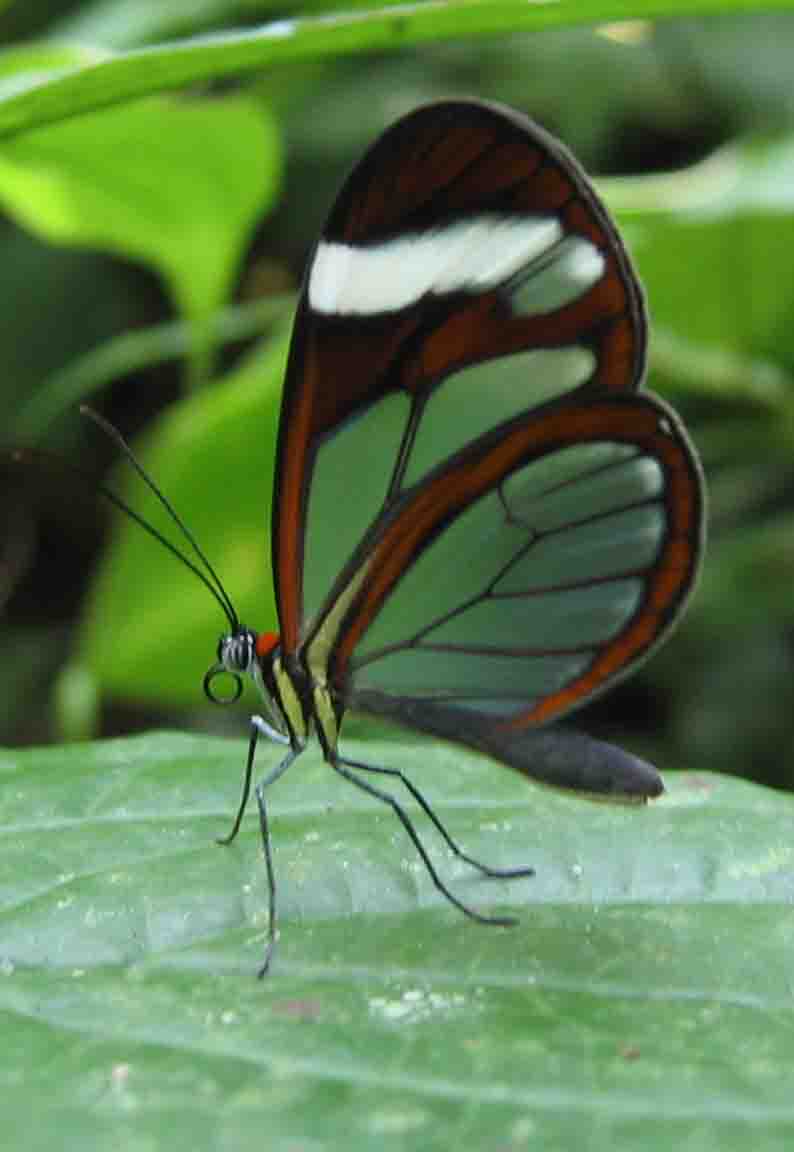
6. Glasswing butterflies. It seems so obvious now. If you really want to blend in and not get noticed, just be see-through! Duh! Props to the glasswing butterfly for having naturally transparent wings, a surefire way to avoid predators. These butterflies are generally found in Central and South America, and must be a real sight to see…if you can see them, I guess. To be honest, anything else I could tell you about the glasswing butterfly, like the fact that they make sure to lay their eggs on the poisonous nightshade plant so that their caterpillars are unappealing to birds and animals, would probably not live up to their unbelievable clear wings, so I will wrap things up here.
Can’t get enough of weird and rare animals? Stay nerdy with these selections:


Catania KC, & Remple FE (2005). Asymptotic prey profitability drives star-nosed moles to the foraging speed limit. Nature, 433 (7025), 519-22 PMID: 15690041
Catania KC (2006). Olfaction: underwater ‘sniffing’ by semi-aquatic mammals. Nature, 444 (7122), 1024-5 PMID: 17183311
Hölldobler B (1976). Tournaments and slavery in a desert ant. Science (New York, N.Y.), 192 (4242), 912-4 PMID: 17817765
Binetti VR, Schiffman JD, Leaffer OD, Spanier JE, & Schauer CL (2009). The natural transparency and piezoelectric response of the Greta oto butterfly wing. Integrative biology : quantitative biosciences from nano to macro, 1 (4), 324-9 PMID: 20023733


