

Should've been more careful around prions...
When I say that prions are one of the coolest biological phenomena in existence, I mean to say that they are one of the most sci-fi and potentially frightening things you could encounter. They are the causative agent behind mad cow disease, which you’ve probably heard of, and which might not seem too terrifying. But the way prions work, and the fact that there is a “human form” of mad cow disease, will be enough to give you the creeps.
Did I mention that prion infection is the closest thing there is to real-life zombie-ism? Okay, okay, what IS a prion?
So, there are viruses, which are responsible for the flu, and there are bacteria, which cause tuberculosis; these are well-known. Even the lesser-known protists, which give rise to malaria, are similar to bacteria (although more complex in structure). Prions, on the other hand, are an altogether different infectious agent.
In simple terms, a prion is an rebellious protein, a protein that has failed to fold up into the proper configuration. And prions take their frustration out on normal proteins by making them fold up improperly, too, thus propagating more prions. In fact, the word “prion” is a contraction of “protein” and “infection.” How do prions work? Not by any means so taxing as invading a cell and hijacking its DNA, or anything like that. As far as we know, normal proteins fall prey to prions simply by physical contact, thus leading to a domino effect of prion creation, which I have tried to illustrate below (afterwards, I’ll show why prion infection is really, really bad).
Let’s say we start with 20 blissful blue proteins, and they’re blissful because each one of them is a nice square shape:
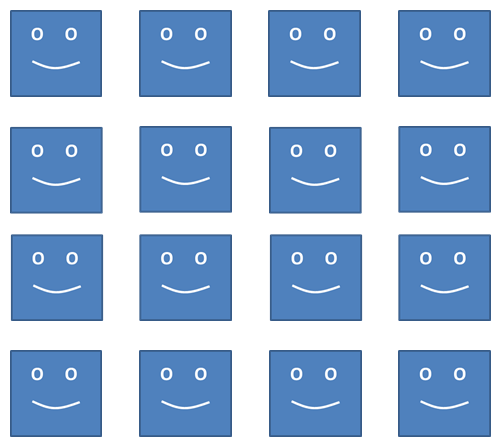
But then a vindictive prion comes along, and it’s angry because it failed at being a square (and because it has a unibrow):

So this prion, like a real class act, takes its feelings out on the nearest normal protein by making contact with it:

And what was a normal protein is now a disgruntled, misshapen prion:

It’s all downhill from here. Two angry prions become four:

Four become eight:

And finally everybody is an angry, bent out of shape (literally) prion:

So why does prion infection matter? And what was I saying about zombies? This is where things get interesting.
As it turns out, cells do not like being full of misfolded proteins. The real problem with prion proteins is that they get tangled up and stick together, forming very large, stable aggregates inside of cells. This leads to cell death and tissue damage, specifically in the brain, where prions wreak their havoc. The picture below on the left shows a brain suffering from prion infection, riddled with holes due to tissue destruction (normal brain tissue is shown on the right at a lower magnification):

The effect of prions on the brain is also visible on a macroscopic scale, as seen in these brain sections where the prion-infected brain is on the left and is visibly deteriorated:

When a cow is infected with prions, it has mad cow disease. When a human is infected with prions, he/she has Creutzfeldt-Jakob disease (CJD; not as catchy). The symptoms of CJD start with dementia (memory/personality loss), followed by speech impairment, jerky movements, and poor balance (not to be insensitive, but this could all describe a zombie, no?)
There are three main ways you can end up with CJD: 1) acquire it, by somehow getting prions into your system from the environment, 2) inherit a mutation that dooms your proteins to become prions, or 3) have the bad luck to spontaneously develop prions in your brain.
 Fore tribe members
While some people worry about eating beef when mad cow disease breaks out, you would have to consume beef that had picked up traces of brain and prion during processing in order to get CJD. What’s more, this and all other acquired forms of human prion diseases make up less than one percent of cases. But since I’m on the topic, I’ll briefly mention that there is a tribe in Papua New Guinea called the Fore tribe, and in the 1950s they had an epidemic of a prion disease called kuru. This happened because it was traditional in this culture to eat the bodies (including the brains) of deceased family members. All it would’ve taken was one person with prion disease to die, then the family would’ve eaten prion-infected brain, which would eventually cause all of them to die, and then be eaten…and so on, until cannibalism was banned later in the ’50s. (Eating brains, developing zombie-like symptoms…the connections are hard to ignore.)
So the #1 rule if you don’t want to acquire prion disease is to not eat brains. Unfortunately, the vast majority (85%) of human prion diseases apparently arise sporadically, perhaps from some spontaneous mutation or conversion of normal protein to prion protein. Researchers say there is no amount of prions too small to cause full-blown disease, and once you’re affected there’s no cure and it’s always fatal. The only real variable is that it can take years of incubation before prion levels rise to symptom-causing levels.
I don’t mean to scare you! Despite all this, a human with prion disease is statistically one in a million. If anything, this post will hopefully prove useful to you the next time you’re in the company of nerdy friends, watching zombie movies, and you can sound extra nerdy: a lot of movies depicting a zombie


 Stay nerdy!


(Side note: I threw in Max Brooks’s World War Z because it’s one of the best novels I’ve read in recent years — a surprisingly sobering and somehow realistic take on a post-zombie apocalypse world. Also, Patient Zero is the first book in a series that I adore by Jonathan Maberry; this book seriously brings hand-to-hand zombie combat to life.)
Trevitt CR, & Singh PN (2003). Variant Creutzfeldt-Jakob disease: pathology, epidemiology, and public health implications. The American journal of clinical nutrition, 78 (3 Suppl) PMID: 12936961
Edgeworth JA, Gros N, Alden J, Joiner S, Wadsworth JD, Linehan J, Brandner S, Jackson GS, Weissmann C, & Collinge J (2010). Spontaneous generation of mammalian prions. Proceedings of the National Academy of Sciences of the United States of America, 107 (32), 14402-6 PMID: 20660771
Fryer HR, & McLean AR (2011). There is no safe dose of prions. PloS one, 6 (8) PMID: 21858197


check out the PATIENT ZERO by Jonathan Mayberry.. It’s about a prion based zombie terrorist scenario..
Oh my goodness, how could I forget – I LOVE the Joe Ledger series! Patient Zero really wowed me as well, I’m going to add it to the post – thanks for the reminder!
The Papua New Guinea kuru outbreak is probably my favorite thing about brains.
Yep, I’m a brain nerd.
And what an excellent kind of nerdiness that is!
Have you seen anything about Fatal Familial Insomnia? It is also a prion disease. It’s a dark family curse–very Edgar Allen Poe!
Yes! It seems like the most unfortunate thing — an inherited prion disease! The course of the disease sounds so terrible…here’s hoping for a cure/treatment!
My question is this: if you must consume the infected tissue, how do zombies transmit the disease? This is my problem with the prion-zombie theory. It’s a misfiled protein that affects the brain and it’s functions, yes…but from what I’ve seen, rabies makes individuals more “zombie-like” because it is actually infectious through saliva. Prions are not…unless I’ve missed something
Brian, prion diseases can actually be passes through infected meat, urine, feces, blood, and god knows how many other ways. They don’t know enough about these diseases to say for sure what it can and can not do in the long run. They found out that even tho prions do not contain any dna or rna, that they can evolve, and this is a disease that we can do nothing to cure, or even slow down. With a incubation period of 10 years for some strains, its hard to say when, where or how these diseases will show their ugly faces. Considering these diseases actually alter your genetic make-up, making this or that part of your brain actually change, this seems like a very plausable cause for zombies. Keep in mind, not all zombies in movies, books, or anything else, transfer their zombiism strictley by bites
